Jala Neti to Enhance SBP

Hi all,

I have long had trouble with the “up on inhale, down on exhale” component of SBP, both because my powers of visualization are somewhat weak, and because the downward movement of the diaphragm on inhalation tends to pull my attention downward.

Recently I noticed that jala neti has become ecstatic in an interesting way. I am not using a pot but rather using my nostrils to directly suck warm salt water up from a bowl. This forceful sucking of warm water up toward the third eye seems to stimulate an ecstatic reflex in the third eye area that is very pleasurable and creates a feeling of energy moving into that area.

Yogani has mentioned before the technique of feeling the coolness of the air in the mouth or nasal passages on inhalation and the warmth on exhalation as a way to connect to feelings of cool and warm currents moving up and down the body during SBP. I have thus far not had much success with this, though I sometimes feel the “minty” feeling in my stomach.

I wonder if this practice of jala neti may also help train the proper movement of attention up toward the third eye on inhalation? That is, one might imagine the attention moving up from the root to meet the point at the top of the nostrils toward which the air moves on inhalation? And then the attention can fall back from that point toward the root as the air goes back down the nostrils on exhalation? And sucking warm water up to the third eye with jala neti could be a way to train this dynamic?
2 Likes

Hi Casey,

If your powers of visualisation in SBP are not strong, it is not an issue. It is possible to practice Spinal Breathing simply by bringing the attention to the perineum at the end of each exhalation and bringing it to the point between the eyebrows at the end of each inhalation. The prana in the body will actually fill in the rest. So, no visualisation is needed at all. This also solves the issue of the direction of movement of the diaphragm, as it would not be relevant.

This is from lesson addition 239.1:

So what about this spinal nerve thing? Many people say they have trouble imagining it going up and down with the breath. Our answer to that has been, “Don’t worry about it. Just make sure you end up at the brow at the end of inhalation, and at the root at the end of exhalation. If you are getting stuck somewhere, just pass over that area and continue between root and brow.” It is fine to use a tactile sense (touch or feel) of the spinal nerve more so than a mental image, if that works for you. When ecstatic conductivity arises, it becomes largely “feel,” so it is okay to start with feel if that is more natural.

That’s it. Very simple.

Those who can imagine the spinal nerve as a tiny tube or thread, will often ask about following the curve of the spinal, forward and back, and even from side to side in cases where there may be a medical condition affecting the alignment of the spine. Others have asked if spinal injuries involving paralysis will affect spinal breathing. In all of these cases, whether attempting to micro-manage the path of the spinal nerve, or wondering if the condition of the physical anatomy will reduce the effectiveness of our practice, the answer is always the same: Don’t worry about it. Just end up at the brow at the completion of inhalation, and at the root at the end of exhalation. The path in-between can be a straight line without any regard for the actual curvature of the spine, or whether there is any spine at all.

If the ecstasy that comes with jala neti helps with cultivating the habit of going up on the inhalation, and down on the exhalation, then that is great. Any aid that helps is a good thing.

3 Likes

Hi Casey,

Are you using mulabandha and sambhavi mudra during SBP? I noticed that it becomes easier to feel the lower parts of the spinal nerve as mulabandha is released or tightened. Similary, sambhavi mudra makes the upper end of the spinal nerve more clearly felt.

But great that Jala Neti does something for you! I haven’t tried it yet, but get increasingly more curious.

Outside your regular practice, you could try out this exercise described from minute 3:40 in this video. It’s designed to develop a felt sense of the spinal nerve.

Just a small “disclaimer” about the video:
There is a bunch of interesting stuff on this Kriya Yoga channel, but much of the advice on practices (including the first minutes of the above video) would be in conflict with AYP philosophy, because focus is put on particular types of scenery, and noticing it during practices as a form of “proof” that the practices are done correctly. In AYP we are advised during our practice not to have a mentality to recreate experiences, and not to actively make a checklist of scenery, and not to favor scenery over the easy practice. Instead whether practices work is to be judged in their effects on normal daily life.

3 Likes

Hi Tensor,

Yes, I do usually use mulabandha and sambhavi during SBP. I can feel ecstasy at the root and third eye sometimes during SBP, or sometimes just by putting my attention at those places and/or performing such mudras and bandhas. I suppose I can sometimes feel or perceive the sushumna as something like a column running through the chakras, but more often I perceive the chakras themselves in a somewhat disconnected fashion.

Thanks for the video–it suggests something I had sort of independently come to, which is that, although the diaphragm goes down on the inhale and up on the exhale, many other things, including the chest and the pressure in nasal cavity go up on the inhale, stimulating the energies on the upper end, while many things compress and/or go down on the exhale, stimulating the energies on the lower end.

My post is less about visualizing the sushumna but more of a possible tip for anyone else who might have trouble understanding the idea of “inhaling into the third eye.” Of course, it might not be so helpful in the earlier stages because it was only recently that I sometimes started to feel ecstatic while performing jala neti.

I performed jala neti for years not primarily with the idea of purifying the nervous system but simply because I have a tendency to nasal congestion, and I think it may reduce the frequency of catching colds and flus. However, in retrospect, it always has stimulated the third eye area to an extent (a friend once said to me it reminded him of the “weird” feeling one would get while swimming if water accidentally goes up one’s nose–a feeling perceived in that third eye area).

So, if one can get some feeling at all, even if not ecstatic, in the third eye area while performing jala neti by sucking water up through the nostrils, it might be helpful for developing the habit of feeling the attention and energy move to the third eye on inhalation, I am thinking.

I also think the fact that jala neti, and presumably some other shatkarmas, can stimulate kundalini (I have felt soma in the digestive tract more often while fasting, for example, and have felt the heart more clearly when performing vastra dhauti (be careful with this one–it is a bit harsh and you don’t want to swallow anything…), suggests the interconnectedness of the more gross physical body and the spiritual neurobiology.

3 Likes

Hi Casey,

I think I have quite sensitive nasal passages, and whenever sea water gets in there (e.g. swimming through crushing waves) it’s not very comfortable. Maybe only because it’s too salty or too unexpectedly pressed in there? There is also this weird experience when eating wasabi. It’s also not pleasant but its interesting to feel the intense sensation traveling up to the third eye region.

About the exercise in the video. There isn’t necessarily any movement of prana on should notice there, it’s more about making the line-like aspect of the spinal nerve felt through that long and complete exhalation. So instead of tracing the spinal nerve during that long exhalation one just introverts the senses into the torso, in particular the sense of touch. So what’s suggested in the video is not supposed to modify SBP, and I wouldn’t recommend doing it for an extended period because I don’t know what that might do. It’s just a way of exposing yourself to a condition that might be more favorable for discovering the felt sense of the spinal nerve, simply because there is less multitasking as in SBP. Just resting the awareness in the torso region, versus tracing the spinal nerve.

Like you describe, I also had for a quite some time a felt sense of chakras, but had absolutely no sensation of the spinal nerve connecting them. That changed with a similar practice as that in the video, I learned in a Buddhist tantra course, where very long and complete exhalations were followed by effortless and rather quick and incomplete inhalations. During this practice I first noticed segments of the spinal nerve in the torso region. That’s why I think the exercise in the video could help you “connecting the dots” of the chakras. Of course, in Spinal Breathing Pranayama there is no need to feel the spinal nerve, because it can still be traced without any felt sense. But once the spinal nerve is felt, the practice of SBP gets easier.

2 Likes

Hi Tensor,

Thanks for sharing the experience. Yes, I think the sensitivity of the nasal passages is directly related to the spiritual/ecstatic potential of the third eye region. Probably most people only usually experience it in a neutral and/or negative way, such as with wasabi or even a migraine or similar headache, but as you know, these nerves can also become activated to experience strong ecstasy (as perhaps all the nerves, eventually, can be?).

If you are wondering about jala neti, I would guess you can probably comfortably do it with warm but not too hot water that is slightly salinated, but not too salty. But if you use a strong inhalation with the nose, it definitely stimulates those nerves. That stimulation is now often pleasurable for me, but I could see it being uncomfortable if too intense (the same is also true of the nasal passages stimulated by the tongue in kechari).

I’m wondering: when you say you felt the spinal nerve in the torso region, did you feel something that felt literally to be within your spinal cord, or more just something running through the middle of the torso? I am feeling something more like the latter in a vague way, but rarely the former, although I do also sometimes feel the spinal cord more clearly. That, however, could be a different meridian from the sushumna (possibly the Daoist “governing vessel,” which runs up the back, rather than the sushumna, which, as I understand it, runs right up the middle, neither more to the front nor back…)?

2 Likes

Hi Casey,

I currently don’t do much energetic practices to stay away from overload symptoms. So, I’ll get back to exploring Jala Neti in the future. And not using the pot, but sucking in the water as you describe, sounds intriguing. For the same reason I also don’t do much kechari at the moment, but just putting the tongue into “stage 2” for a few seconds has a noticeable boosting effect on Deep Meditation for me. So rather than keeping the tongue in kechari throughout DM, I just put it there right before for a few seconds. That’s just my current habit, and I also plan to go back to keeping the tongue in kechari in the future. Kechari 2 can also make it easier for me to feel the spinal nerve when I do a longer (10 min) SBP session, but currently I do a very short (3 min) SBP session, and there I noticed that kechari 2 seems to be more distracting than assisting SBP.

About your question. Indeed, in that Buddhist tantra course the “central channel” was pointed out to be in the center of the torso and not in the spine. However, if I remember correctly I didn’t feel it that way. Instead I felt it more like it was going along the spine. Not sure if inside the spine though or directly in front of the spine (like suggested in the video). That’s a tricky thing to say, being not an expert in anatomy and because the felt sense back then would come alive only deep in meditation. Yogani pointed out that the route and shape of the spinal nerve can change over the years, usually starting closer to the spine in the beginning and then moving towards the center of torso (but not at the front or back of the torso) and becoming thicker:

The spinal nerve is more in the center of the body than in the back, and in the throat area it is right behind the back of the throat and esophagus (gullet). As ecstatic energy awakens and expands, it is found to be even more in the middle, and less following the physical anatomy of the spine, passing through the entire region of the throat instead. That is what happens as the spinal nerve awakens – it expands from the center to become a large column of energy, eventually reaching far beyond the body itself. That is ecstatic radiance.

In lesson 44 Yogani writes

What we are doing in spinal breathing is simultaneously finding the spinal nerve and opening it. We find it by opening it, and then we keep opening it. It will not be the imagination alone for very long.

This last quote matches my experience. After having switched to AYP I felt more and more of the entire length of the spinal nerve simply through doing SBP, and trusting its process of purification and sensory refinement. First, the spinal nerve just became easier and more reproducible to feel during SBP, and eventually the felt sense basically never left throughout the day. It’s always readily available. This has been a very gradual process, and from the first quote above I expect the process to continue in fascinating ways. So, while I believe that SBP is sufficient to make eventually that felt sense appear out of nowhere, it might still be ok to look for it with some extra dedication outside AYP sitting practices for a limited time. A limited time is enough because once the spinal nerve (or segments of it) are felt a single time, it becomes very easy to feel it again. So that’s why I think a single or a handful of such dedicated 5 minute explorations of the torso as described in the video can be a good thing.

2 Likes

Hi Tensor,

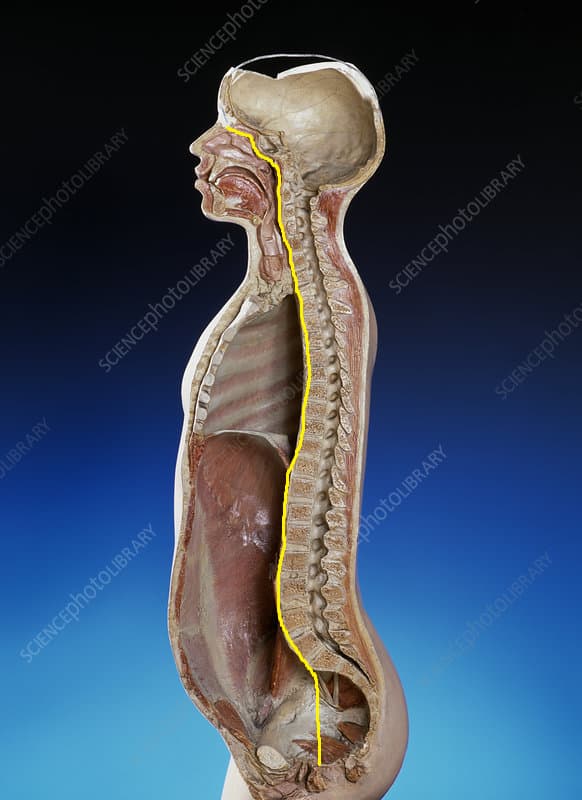
The quote from Yogani about the spinal nerve running just behind the gullet, along with your video about feeling compression on the exhale, have helped me to a realization (somewhat obvious in hindsight), which is that many or most of the mudras, bandhas, and pranayama techniques have the effect of putting mild pressure on, or otherwise “massaging” a line of nerves that runs approximately where I have drawn in this image–that is, from the top of the nasal cavity, down the back of the nasal cavity, down the back of the esophagus, down behind the heart and near the back of the lungs (which also press back on inhalation), down behind the intestines and abs (which press/massage on it during uddiyana/nauli), and to the perineum (which gets massaged/stimulated by mulabandha).

As I am drawing it, this is, of course, somewhat in front of the location of the actual spinal cord, but since the sushumna is more in the middle and it may be hard to directly stimulate the nerve that is protected by so much bone and cartilage, perhaps this is more where we tend to feel it/are able to mentally “access” it?

2 Likes

That’s a very interesting question to what extent the spinal nerve has a physical correlate. Given that subjectively the route and size of the sushumna is changing over the years of practice, then if there was a correlate it must also be fluent. Then there are also nadis that are clearly outside the body, like to one going to the crown. So, if there was a correlate for them it must be purely encoded as a spatial representation in the brain (like a phantom limb).

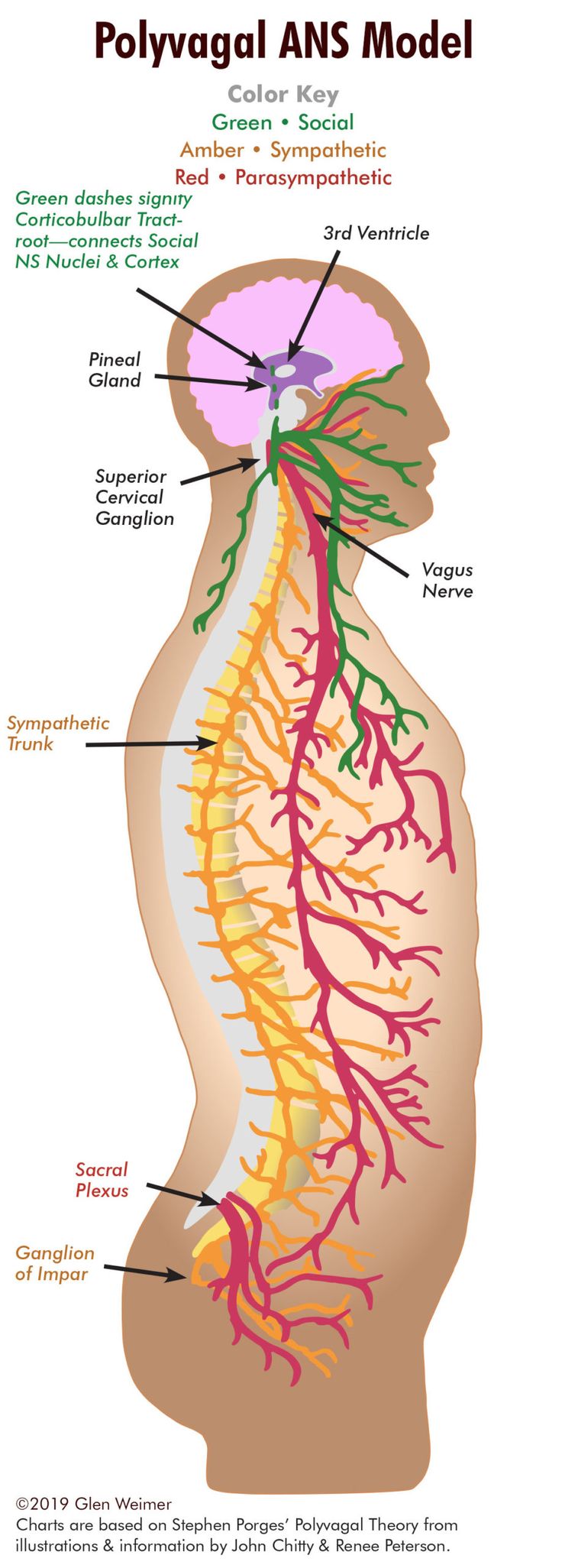
In the video, it is claimed that sushumna is the dorsal vagal nerve. I’m not aware of any scientific source behind this claim, or if it is just a hypothesis.

Here is a nice graphic showing the vagal nerves, with the dorsal vagal in red. The location certainly seems to roughly match Yogani’s description and your drawing.

4 Likes