You write that spinal breathing makes your energy more intense to the point that you need to stop. It might be your expectation is that SBP quiets down your mind and that you dismiss it’s effects because it does the opposite.
If so, you should not discard SBP, but recognize that it is very powerful when combined with DM. A lot of practitioners make this experience. You could pause with SBP for a while and see if you can find a stable routine with just DM. When you have reached this baseline, you can gently introduce a short time of SBP an slowly build up until you feel that things are becoming too intense again. Then again take a step back to a routine that you can hold up long term without difficulties. This is to get into the car, that you can learn to drive afterwards.
Keep in mind, that stability can not be recognized in one sitting, since some effects need to fade out/accumulate over days.
I am not trying to quieten down my mind. I have an active kundalini rising or purification (whatever it is called) and I am trying to use SPB to cleanse the nadis so that the energy will eventually go through shushumna nadi. This is how I at least understand it.
When I do DM, my energy starts to surge too intensely. There are times I am able to do longer meditation but depending on the day, I have to ground and pace my meditation practices. Today is a bad day, only able to do max 10min before it becomes too painful
Two more questions. Can I do SPB with my eyes open or when I go for a walk? Is it any effective or beneficial?
Is SPB like an alternative version to Soham ajapa japa pranajama? What is the difference in terms of benefit?
You have already received good advice from others. If you are finding that Spinal Breathing and Deep Meditation are producing too much intensity (too much purification) then you may find it easier to switch to using Alternate Nostril Breathing and Breathing Meditation for a while. This is discussed in Lesson 367:
It is preferable to find a practice routine that is comfortable and not leading to energetic overload. You could try this for six months and then see how you feel. If you feel stable at that time, you could switch back to Deep Meditation and then after a few months re-introduce Spinal Breathing again. Be sure to back off if necessary.
There is a free PDF on how to self-pace the AYP practices which can be downloaded from here:
To answer your questions regarding Spinal Breathing:
Yes, Spinal Breathing can be practiced with the eyes open, although it is less effective than with the eyes closed.
If the version of Soham Ajapa Japa Pranajama involves tracing the Spinal Nerve with the attention between the root chakra and ajna chakra, then yes it is an alternate version. The main difference being that no mantra is used during the practice. This means that the mind is divided less and there is a single point of focus for the attention which is the Spinal Nerve. This means that the purification happens differently. With Soham Ajapa Japa Pranajama some purification is being caused by the mantra and some by the process of moving the attention along the Spinal Nerve, but with AYP SBP all the purification is coming from the tracing of the Spinal Nerve with the attention. How that plays out for any given individual will depend on their specific karmic matrix of obstructions which changes over time.
“Following the spinal nerve with one’s attention” can include some temporary variations on that such as jumping with one’s attention between the two end points. It can also include skipping over parts of the spinal nerve that are difficult to move through.
I’d like to share a little “progress” I’ve noticed that I can follow the “recommended” path for spinal breathing if I move my attention along it a little faster.
So I don’t adjust the speed exactly to my breathing, so that I arrive at the respective endpoint precisely at the end of each inhalation and exhalation. I move through the path in between more quickly (sometimes much faster, sometimes just a little), and then keep my attention on the endpoint until the end of the breath.
This is working really well for me right now. I’m trying to visualize less and focus more on feeling the path. It’s similar to a body scan, except I’m moving through the path relatively quickly.
Moving through it more quickly helps my mind let go of the tendency to want to follow the path as precisely as possible.
Thank you for the discussion. Really helped me with understanding. I have been doing SBP and deep meditation more than a year. With DM, I see the changes which is incredible. Especially witness where you start to see the thoughts as objects and decide whether you want to engage it. There is a small gap emerging between thought and response which is really game changer. Thank you yogani for this wonderful gift.
With SBP though, I wasted a whole year trying to force or trying to see spinal nerve. It was frustrating for a while but now I try to flow with the breath instead of trying to visualize it. Much more easier and I am still trying to undo previous conditioning and let go and try to enjoy it.
I guess the strong desire with impatience to see spinal nerve. Now I accept that it will be few years or longer to awaken the energy. Nowadays, my only duty is do the daily sittings and surrender to whatever to come.
Yes, there is no need to be able to see the spinal nerve in order to practice Spinal Breathing, and straining to see it would be counter-productive. As you say, it can take years to reach that stage. Quite often people will find that they can feel the prana flowing through the spinal nerve before they are able to see it. But, there is also no need to feel this. It will happen when it happens.
Being able to simply practice and enjoy the practice as it is, with no expectations, actually brings the fastest progress.
I’m glad the discussion is helping you on your journey. The answers have helped me a lot too.
After a bit of back and forth (as you can tell from my questions :)) I’ve also decided to keep it very simple and just focus on the two endpoints when it comes to the SBP. I’ll stick with that until it naturally ‘evolves’ further on its own.
I try to go into every session without any expectations. But the positive effects outside of formal meditation are impossible to overlook. It’s fantastic to see what happens after such a relatively short time. And even during the meditation itself, I’ve already had one or two truly extraordinary experiences.
But what matters most to me is that I’ve finally found a sadhana that really ‘works’ for me. One that can be adapted to my current situation and that I look forward to every day. For the first time, it’s not a case of ‘I have to meditate today’, but a practice that I really WANT to do. Every day. As you said: what a gift from Yogani.
And all the wonderful teachers and fellow practitioners who keep the community alive are just as much of a huge gift.
Same here. Nowadays, i mainly look forward to the sitting. After this simple change, “just focus on the two endpoints”, man it feels so relaxing. I also try to extend exhale 2-3 seconds which is fantastic and get into calmer state much faster.
I occasionally experiment with one variation of SBP or another, so I thought some of my “findings” might be helpful to others as well.
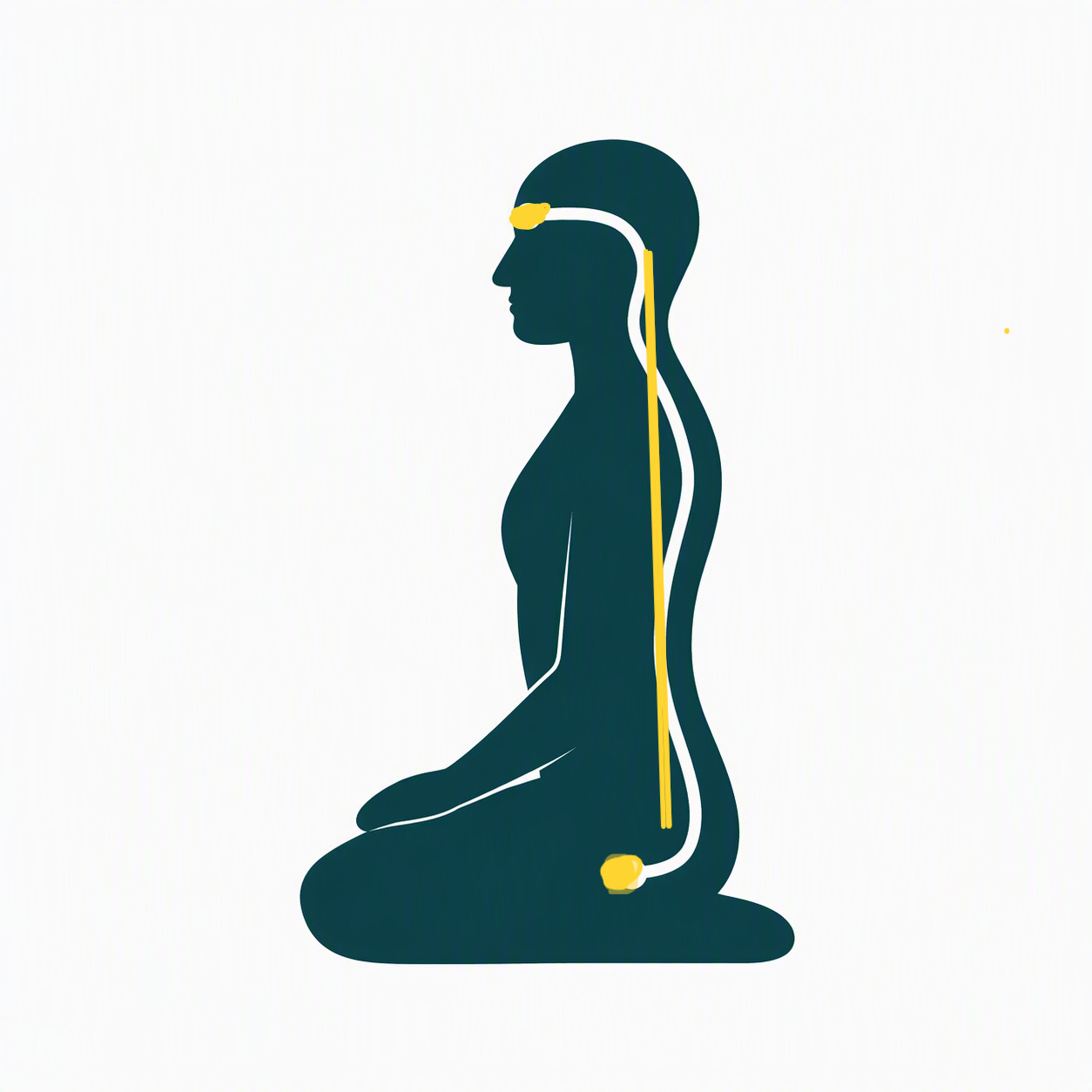
One variation that also seems to work quite well for me is to jump directly from the endpoint to the spine (at the bottom, around the tailbone), then move straight upward along the spine, similar to a body scan, so more about feeling rather than actually visualizing. From the top of the spine (or the center of the head), I then jump directly to the forehead.
So basically, I leave out the “arcs” or branches from the spine to the endpoints and simply jump at those points instead (see illustration).
Just to make sure: I assume this variation is perfectly fine as well? I just want to make sure I’m not sharing supposed “tips” here that might end up doing more harm than good.

 I’ve noticed that I can follow the “recommended” path for spinal breathing if I move my attention along it a little faster.