In this thread I’d like to take a closer look at the core of Yogani’s Deep Meditation instructions from Lesson 13:
Find a quiet, comfortable place where you can sit, preferably with back support. We want to remove unnecessary distractions. Just sit and relax somewhere where you can close your eyes for twenty minutes without interruptions.
Once you have gotten comfortable, slowly close your eyes. You will notice thoughts, streams of thoughts. That is fine. Just observe them without minding them. After about a minute, gently introduce the thought …I AM… and begin to repeat it easily and effortlessly in your mind. If your mind wanders off into other thoughts, you will eventually realize this has happened. Don’t be concerned about it. It is natural. When you realize you are not repeating the mantra, gently go back to it. This is all you have to do. Easily repeat the mantra silently inside. When you realize you are not thinking it, then easily come back to it. The goal is not to stay on it. The goal is to follow the simple procedure of thinking the mantra, losing it, and coming back to it when you find you have lost it. Do not resist if the mantra tends to become less distinct. Thinking the mantra does not have to be with clear pronunciation. I AM can be experienced at many levels in your mind and nervous system. When you come back to it, come back to a level that is comfortable, not straining for either a clear or fuzzy pronunciation.
Do this procedure for twenty minutes, and, then, with your eyes closed, take a few minutes to rest before you get up.
[Yogani]
My plan is to go through these instructions sentence by sentence, because each sentence is equally important for establishing an effective and safe Deep Meditation practice.
Who is this for? If you haven’t practiced Deep Meditation for at least a few weeks, this thread may be “too much information”. It is probably better to simply read the instructions above, practice, and then re-read and practice again until you have developed some intuition for it. If you have been practicing for longer, this thread may be useful to you. A more detailed conceptual understanding in your left brain can subconsciously help your right brain and so improve your skill in meditation. Think of a musician: reading about music theory can indirectly improve their playing, even though they don’t think about theory while they play. So the idea is not to actively apply anything you read here in your practice but just to allow the information to sink in. Taking a closer look can also deepen your bhakti for Deep Meditation practice. On the other hand, if you find my analysis confusing rather than clarifying, please don’t take that as a sign that you’re doing something wrong. Not everyone benefits from analysis: there are excellent intuitive musicians who have never learned music theory, and telling them they need to understand it might only bog them down rather than improve their playing.
Topic 1: The procedure of Deep Meditation
Today let’s look at this part:
[R]epeat [the mantra] easily and effortlessly in your mind. If your mind wanders off into other thoughts, you will eventually realize this has happened. Don’t be concerned about it. It is natural. When you realize you are not repeating the mantra, gently go back to it. This is all you have to do. Easily repeat the mantra silently inside. When you realize you are not thinking it, then easily come back to it. The goal is not to stay on it. The goal is to follow the simple procedure of thinking the mantra, losing it, and coming back to it when you find you have lost it.
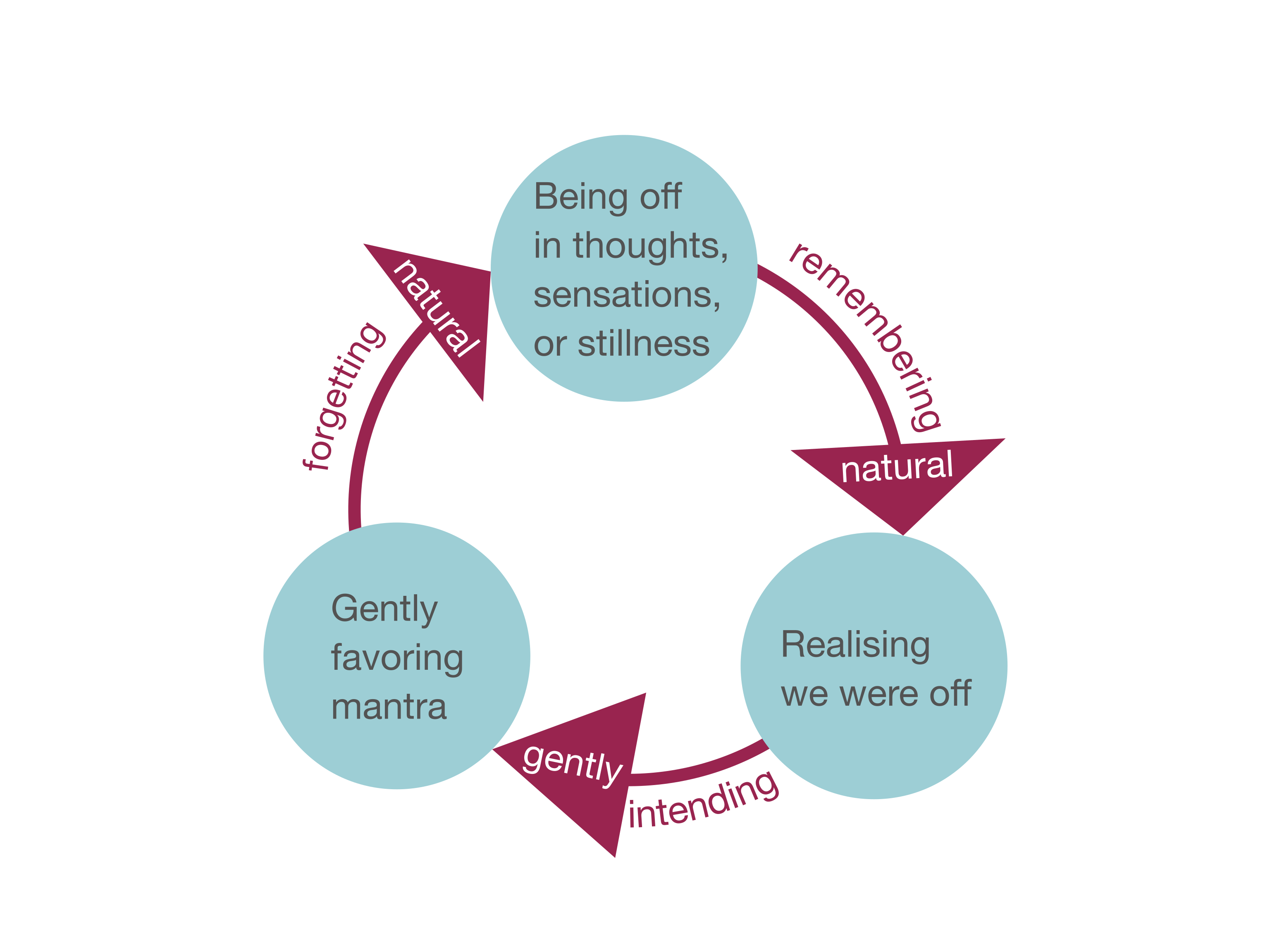
Here is a drawing of the process these sentences describe:
Take a moment with it before reading on. Does it match the passage above, and can you relate it to your own experience of Deep Meditation?
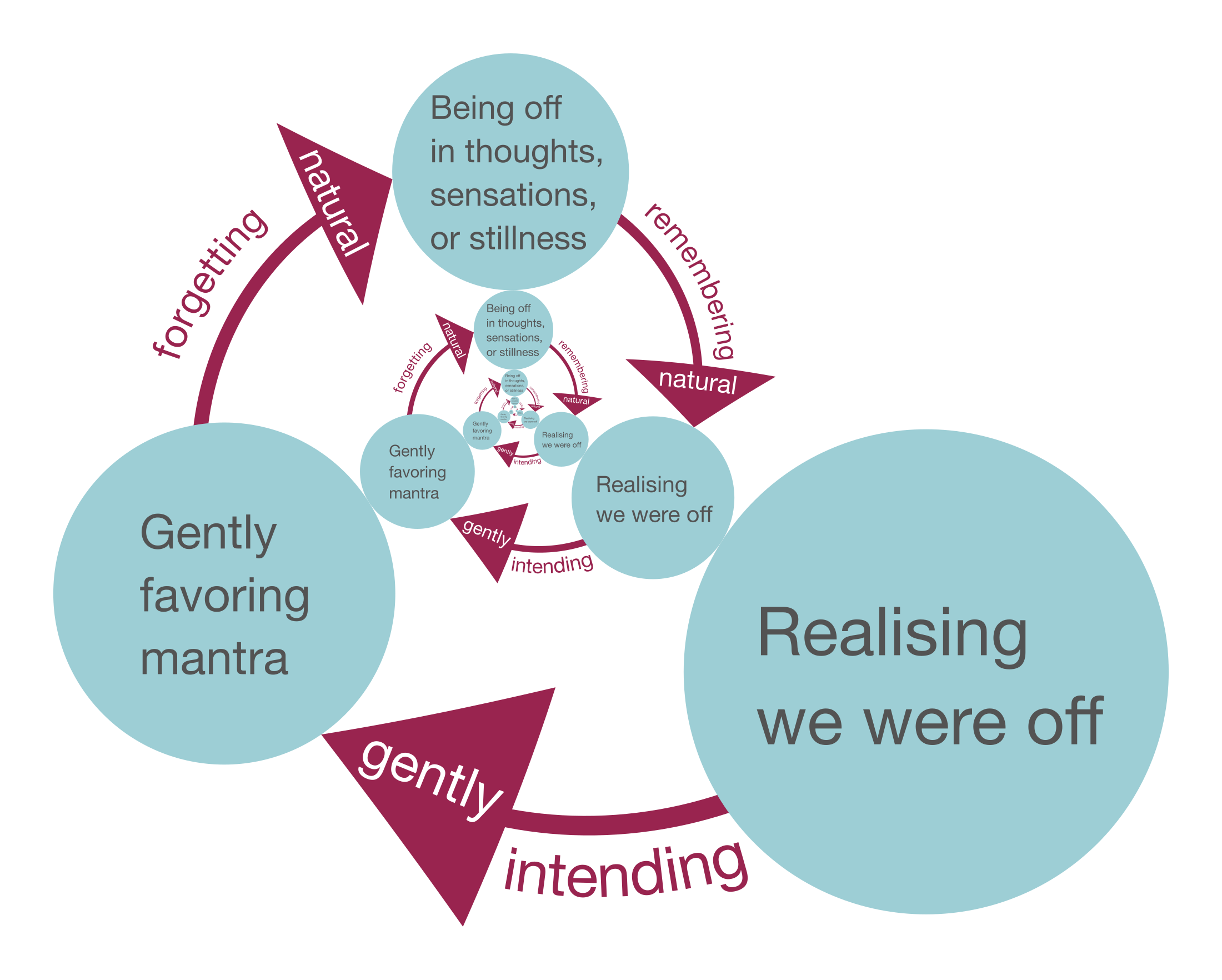
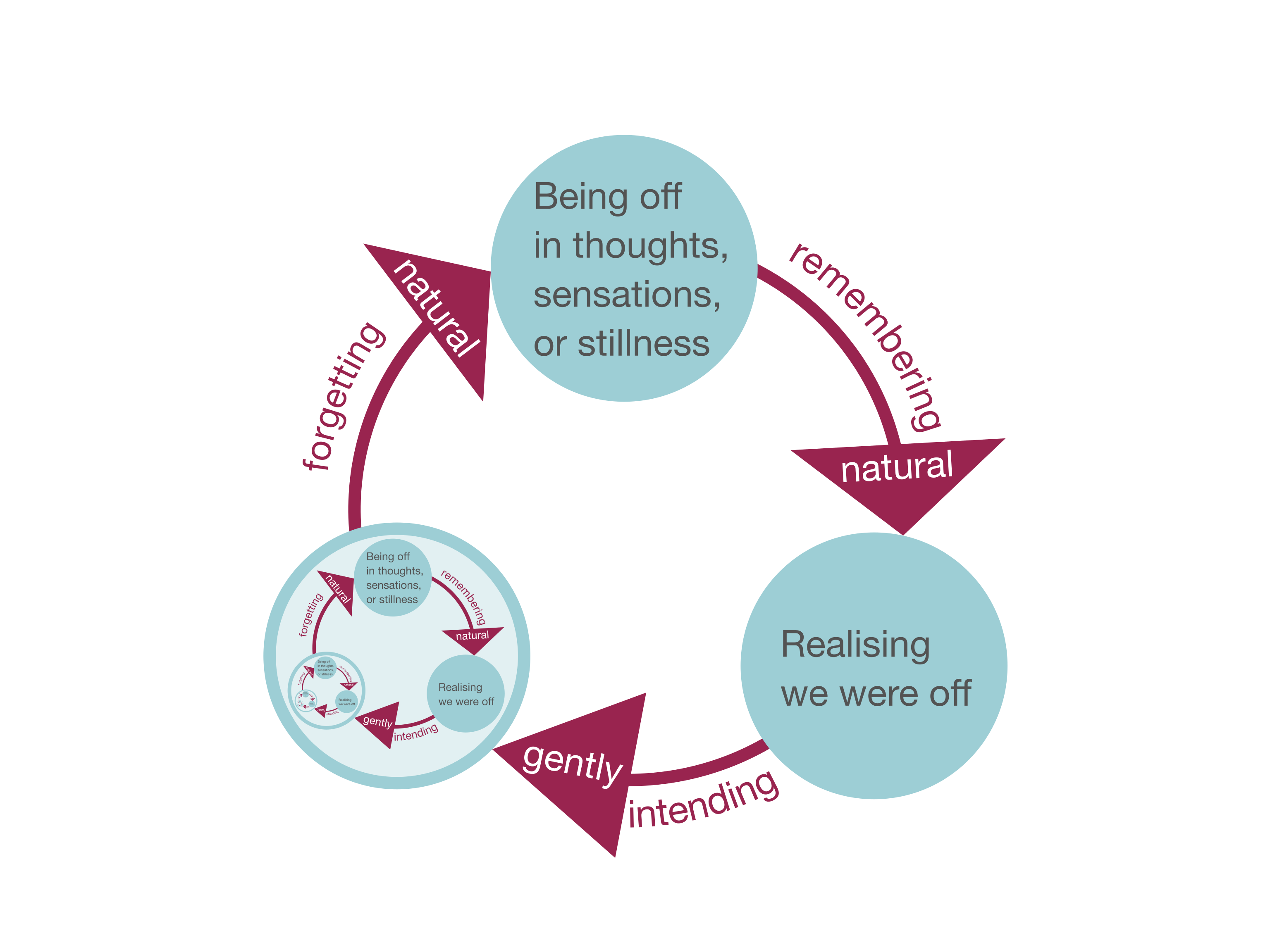
The drawing is a loop: a repeating process that can be roughly divided into six parts, which I have drawn as three blobs and three arrows.
One might think that “Gently favoring mantra” is the only part of the loop that matters. That would be a mistake, and it is why I drew all three blobs in the same style: it would not be correct practice to try to stay in “Gently favoring mantra” alone, with the agenda of never losing the mantra.
Losing the mantra is one way of forgetting to gently favor it. The most common way is probably to lose the mantra into thoughts or sensations, but there are others, for example forcing the mantra, or favoring another thought with the mantra in the background. In these two cases the mantra isn’t lost, yet we are no longer doing the part of the instruction that says: “Easily repeat the mantra silently inside.” Because we favor the mantra gently, forgetting to favor it is natural, which is why I labeled the arrow “forgetting” with “natural”. There is no point in trying not to forget the mantra; that would be a departure from the simple procedure of Deep Meditation.
Once we have forgotten to gently favor the mantra, we may be favoring other thoughts or sensations, we may be in stillness, or we may have started to force the mantra without noticing. In all of these cases we will eventually, and just as naturally, remember what we are doing. This realisation that we were off can come as a clear thought, or it can barely register.
Now the instructions tell us to gently return to the mantra. This is part of our intention when we sit down to meditate: whenever we have the choice, we take this step and gently return to the mantra, rather than consciously deciding to stay with the thoughts or sensations. If the mantra cannot be gently favored, we don’t force it. We will come back to this later in the thread, when we look at this part of the instructions that explains how to enter the procedure of Deep Meditation in the first place:
Once you have gotten comfortable, slowly close your eyes. You will notice thoughts, streams of thoughts. That is fine. Just observe them without minding them. After about a minute, gently introduce the thought …I AM…
Notice that gentleness applies both to how we think the mantra and to how we return to it after losing it. This will be important for the second part we’ll look at next time:
Do not resist if the mantra tends to become less distinct. Thinking the mantra does not have to be with clear pronunciation. I AM can be experienced at many levels in your mind and nervous system. When you come back to it, come back to a level that is comfortable, not straining for either a clear or fuzzy pronunciation.
Feel free to ask questions, or propose corrections and improvements.